Cyclades Islands Travel Guide: Best Beaches, Restaurants & Luxury Villas
What does it actually feel like to arrive somewhere and immediately understand why people never quite manage to leave? The Cyclades have been answering that question for centuries. There is something in the quality of the light here – the way it hits whitewashed walls and bounces off the Aegean with a kind of reckless brilliance – that makes the rest of the world feel slightly underlit. Thirty-three inhabited islands scattered across the southern Aegean like an afterthought by someone with excellent taste: each one distinct, each one quietly certain it is the best one. They are not wrong.
This is a destination that works with equal conviction across a remarkable range of travellers. Couples marking something significant – a milestone birthday, an anniversary, the decision to finally do the trip they keep postponing – find in the Cyclades a backdrop that does not disappoint. Families seeking genuine privacy rather than the performative seclusion of a hotel “family suite” discover that a private villa here changes the entire equation: children in the pool, adults with a cold glass of Assyrtiko watching the sun melt into the sea. Groups of friends who have been trying to coordinate a trip for three years and finally managed it will find the islands generous, varied and pleasingly resistant to being done in a single visit. Remote workers who need reliable connectivity alongside something resembling beauty have increasingly found the Cyclades – particularly Mykonos and Santorini – surprisingly well-equipped for the working-from-somewhere-better school of thought. And wellness-focused guests, drawn by the pace, the sea, the quality of the silence between activities, have been arriving here for years with that particular look of people who have made a very good decision.
Getting to the Cyclades: Less Complicated Than You Might Think
The two main gateways into the Cyclades are Athens International Airport (Eleftherios Venizelos) and the islands’ own airports, of which Santorini (Thira) and Mykonos have the busiest international traffic. Direct flights from London, Paris, Amsterdam, Frankfurt and most major European hubs operate throughout the summer season, with Santorini and Mykonos served directly by Aegean Airlines, Olympic Air, British Airways, easyJet and a roster of charter operators that expands meaningfully from June onwards. The shoulder season – May and September in particular – sees slightly reduced direct connectivity but meaningfully reduced crowds, which most experienced Cyclades visitors consider an excellent trade.
For islands beyond the big two – Paros, Naxos, Milos, Folegandros, Syros, Sifnos – the usual route is a connection through Athens or a ferry from Piraeus, the port city that sits just outside Athens like an industrious relative who never quite gets invited to the good parties. The ferry network is genuinely excellent once you understand it: fast ferries (roughly 2.5 to 5 hours from Piraeus depending on destination) and slower overnight services run year-round, though frequency increases dramatically from April to October. Hellenic Seaways and Seajets operate the high-speed services; Blue Star Ferries handles the more leisurely crossings. Island-hopping by ferry is one of the great Mediterranean pleasures, best enjoyed with good weather, a good book and no particular deadline. Flying between islands is also possible on smaller regional routes, though for many travellers the ferry simply is the experience.
Getting around within islands varies enormously. Mykonos and Santorini have ATVs, scooters and car hire available everywhere (with the driving confidence that implies). Naxos rewards a proper hire car – it is large enough to explore meaningfully. Smaller islands like Folegandros and Sifnos move more slowly, and that is rather the point.
Eating in the Cyclades: Where Simplicity Becomes an Art Form
Fine Dining
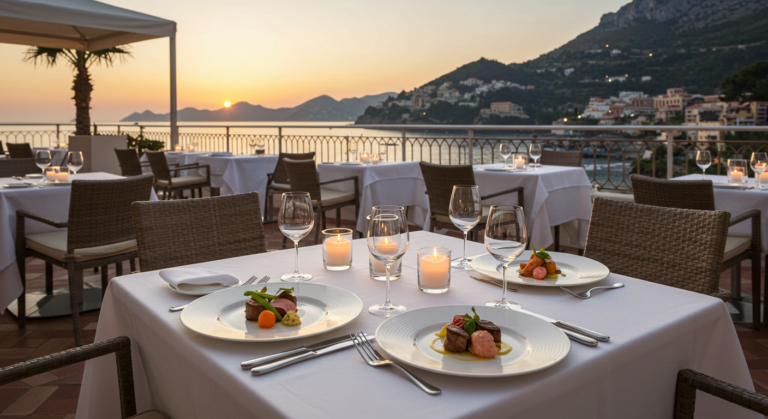
The Cyclades have matured considerably as a fine dining destination over the past decade. Santorini in particular has developed a serious restaurant scene – one that uses the island’s extraordinary volcanic terroir as both larder and inspiration. The island produces its own cherry tomatoes (sweeter and more intensely flavoured than anything grown in less dramatic soil), white aubergines, capers, and the famous Assyrtiko grape, and the best restaurants here build menus around this local specificity rather than importing a generic Mediterranean experience. Mykonos, meanwhile, skews slightly more international in its fine dining – there is no shortage of very well-executed contemporary cuisine here, with an emphasis on fresh seafood prepared with a lightness of touch that suits the climate. Look for restaurants that work directly with local fishermen and that change their menus according to what actually came in that morning. The ones that don’t are easy to spot. They tend to have very large, laminated menus.
Paros has quietly built a reputation for excellent food that operates well below the radar of the more famous islands – its combination of local produce, talented young chefs and a clientele that tends to stay longer (and therefore care more about where they’re eating) has produced a food scene worth going out of your way for. Naxos, the largest and most agriculturally rich island in the group, produces its own cheeses – graviera and arseniko among them – along with potatoes, citrus and excellent meat, and its restaurants reflect this abundance in a way that is satisfying in a different register to the seafood-focused islands.
Where the Locals Eat
The taverna remains the essential unit of Cycladic social and culinary life, and it is worth understanding that the best ones are not always the ones most visible from the harbour. The rule of thumb about walking slightly further and looking for handwritten menus holds here as reliably as anywhere in the Greek Islands. A proper Cycladic meal at a good taverna involves quantities of grilled octopus (dried in the sun, then charcoal-grilled – the texture is nothing like the rubbery version you get elsewhere), fried courgette balls (kolokithokeftedes), taramasalata made on the premises, fresh feta drizzled with oil and scattered with oregano, and whatever the sea offered up that morning. The bread, if you are anywhere good, will be excellent. Order a carafe of house wine. It will be fine. Sometimes more than fine.
Beach clubs operate as a serious social institution in Mykonos particularly, where the daytime eating-drinking-music continuum can extend well into the evening. Paros and Antiparos have their own more relaxed versions. The morning market culture in Naxos Town is worth experiencing properly – the island produces so much of its own food that a wander through Naxos market feels genuinely agricultural rather than decorative.
Hidden Gems Worth Seeking Out
The best kept secrets in Cycladic eating tend to share certain characteristics: a location that requires knowing someone or having done the reading, a menu that has not changed because it does not need to, and an owner who is either very old or related to someone very old. The tiny family-run places in the chora (main village) of Folegandros, the fish tavernas on the back streets of Milos’ coastal villages, the places in Syros (the islands’ administrative capital and one of its most underrated) where the local loukoumades – small honey-drenched doughnuts that have no business being as good as they are – are made to an ancestral formula. Sifnos has a particularly strong culinary tradition and is famous within Greece for producing a disproportionate number of the country’s best chefs. If you eat one slow-cooked chickpea stew anywhere in the Aegean, eat it in Sifnos.
The Coastline: How Many Shades of Blue Is Too Many?
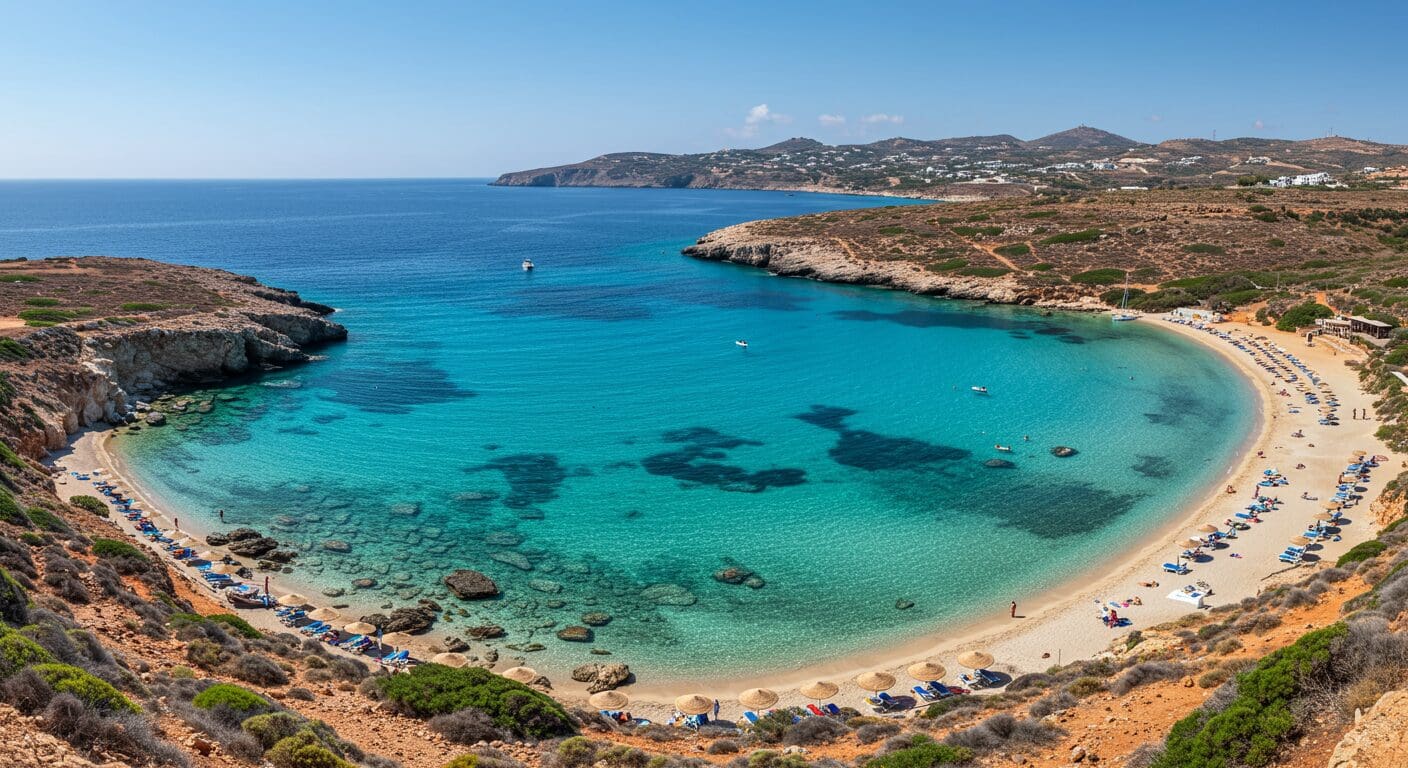
The question answers itself after about twenty minutes on a Cycladic beach. The Aegean here is not a single colour but a conversation between colours – the shallow, almost translucent turquoise near the shore, the deep cobalt further out, the way it shifts to something almost violet in the evening light. Each island offers its own coastal character, and part of the pleasure of the Cyclades is that they are genuinely varied: volcanic black sand beaches in Santorini (Perissa and Perivolos among the most accessible), the long golden stretches of Naxos (Agios Prokopios and Plaka are among the finest beaches in the entire Aegean), the dramatic white limestone cliffs and turquoise coves of Milos.
Milos deserves particular mention for anyone who believes they have already seen good beaches. Sarakiniko, with its lunar white rock formations and electric blue water, is one of those places that photographs do not adequately prepare you for. Kleftiko – accessible by boat – is a series of sea caves and arches carved into white volcanic rock that feels like a film set that no one has got around to using. Paros has Kolymbithres, a stretch of beach where smooth granite boulders have been shaped by the sea into something that reads as both geological accident and landscape sculpture.
Mykonos offers beach clubs alongside its beaches – Nammos and Scorpios among the most famous, with the inevitable combination of excellent music, excellent food and prices that suggest the sun adds a premium. There is a beach for every mood in the Cyclades, which is useful given how many moods a good holiday generates.
Things to Do: The Cyclades Will Keep You Pleasantly Occupied
There is a type of visitor who arrives in the Cyclades planning to do very little and finds, slightly to their own surprise, that the islands keep presenting reasons to move. Day trips between islands are one of the great pleasures here – the ferry between Paros and Antiparos takes ten minutes and deposits you on an island of striking simplicity and calm. The boat trip around Milos takes in coastline and sea caves that are not accessible any other way. Santorini’s caldera – the collapsed volcanic crater that gives the island its distinctive horseshoe shape and most of its drama – rewards exploration by boat in a way that the cliffside view, however spectacular, cannot replicate.
Wine tourism has developed meaningfully on Santorini, where the volcanic soil produces Assyrtiko grapes grown in the distinctive basket-trained kouloura method (the vines are trained in spirals close to the ground to protect them from the wind – it looks eccentric and produces extraordinary wine). Several estate wineries now offer serious tasting experiences. Naxos has its own drinks traditions, including a locally produced citron liqueur (kitron) that is unique to the island. Visiting the distillery is a small pleasure that punches above its weight.
Cooking classes, typically based around local ingredients and traditional methods, are widely available and consistently better than the equivalent experience elsewhere – partly because the ingredients are so good and partly because Cycladic cooking is simple enough to be genuinely teachable. Sailing charters – half-day, full-day, or multi-day – are one of the finest ways to experience the archipelago, allowing access to quieter coves and enabling island-hopping at a pace the ferry timetable doesn’t permit. The best things to do in the Cyclades Islands tend to involve water in some form, which is convenient given the quantity of it available.
Adventure on the Water (and Above It)
The Aegean is a serious sailing destination – the Meltemi wind that blows strongly from July through August is famous among sailors for being consistent, powerful and occasionally humbling. This makes the Cyclades one of the best sailing grounds in the Mediterranean for experienced sailors and a genuinely exciting destination for those chartering with a skipper. Regattas operate throughout the season, and the inter-island distances are well-suited to multi-day charters that combine sailing with stops for swimming, eating and the particular pleasure of arriving somewhere by sea rather than airport.
Kitesurfing has found a natural home in the Cyclades thanks to the Meltemi, with Paros – particularly the bay at Pounda – established as one of the premier kitesurfing destinations in Europe. Instruction and equipment hire are both available at a serious level. Windsurfing has a long tradition on Paros and Naxos for similar meteorological reasons.
Scuba diving is excellent around Milos in particular, where the volcanic geology creates underwater formations of genuine drama – caves, arches and walls that reward both experienced divers and novices doing their first discovery dives. The water visibility in the Cyclades tends to be exceptional. Hiking is underappreciated as a Cycladic pursuit: the islands’ ancient footpaths (kalderimia) connect villages across rocky terrain with views that make the effort comprehensively worthwhile. Naxos has perhaps the best hiking infrastructure, but Folegandros, Amorgos and Sifnos all offer serious walking that most visitors miss entirely because they are on the beach. Which is also a perfectly reasonable choice.
The Cyclades with Children: Better Than the Brochure Suggests
The honest answer about travelling with children in the Cyclades is that the experience varies enormously depending on how you do it. Mykonos and the more social end of Santorini with small children in high summer requires a certain commitment to chaos that not everyone possesses. But this misses the point, because the Cyclades as a family destination comes into its own precisely when you move away from the main tourist arteries – and particularly when you base yourself in a private villa with a pool.
The private pool changes the family holiday in ways that are difficult to overstate. It removes the central anxiety of supervised swimming in an unfamiliar sea. It provides a reliably available activity that absorbs the hours between beach excursions and dinner. It turns the villa into a destination rather than merely accommodation. Naxos is widely regarded as the most family-friendly of the major Cycladic islands – its beaches are long and shallow-shelving, the island is large enough to provide variety, and it is quieter than Mykonos or Santorini without being remote.
Paros has a similarly family-friendly character. The archaeological sites – Delos in particular, accessible by short ferry from Mykonos, is one of the best-preserved ancient sites in the entire Aegean and surprisingly engaging for children who have been adequately briefed in advance – provide cultural substance alongside beach time. Ferry travel between islands is genuinely exciting for most children, which is a useful quality in a transport method. The Cyclades reward the family that comes with some flexibility and a villa base to return to each evening.
History, Architecture and the Weight of Ancient Things
The Cyclades have been inhabited for approximately five thousand years, which the islands wear with the casual ease of somewhere that has simply always been important. The Cycladic civilisation – which produced the famous abstract marble figurines now displayed in museums across the world – flourished here between roughly 3200 and 2000 BC, and the islands have been continuously significant ever since: as a trading crossroads, a religious centre (Delos was considered the birthplace of Apollo and was one of the most sacred sites in the ancient Greek world), a Venetian possession, an Ottoman territory, and eventually part of the modern Greek state.
Delos is one of the most extraordinary archaeological sites in the Mediterranean – an entire ancient city frozen in place on a small uninhabited island, accessible only by day trips from Mykonos. No one is allowed to stay overnight on Delos, which adds to its peculiar, slightly otherworldly quality. Akrotiri in Santorini is another remarkable site: a Minoan Bronze Age settlement buried under volcanic ash in around 1600 BC and preserved in extraordinary condition, often described as the Aegean Pompeii, though Santorini’s claim to be connected to the Atlantis legend is, it’s fair to say, enthusiastically pursued.
The vernacular architecture of the Cyclades – the cubic white houses, the blue domes, the narrow paved paths designed to slow donkeys rather than accommodate cars – is not accidental. The whitewash was historically mandated as a hygiene measure, but the aesthetic effect has proved remarkably durable. The chorae (main villages) of Folegandros, Sifnos and Syros are among the most architecturally coherent in the islands. Syros, the administrative capital of the Cyclades, has a capital city (Ermoupoli) with a genuinely handsome 19th-century neoclassical centre that feels like an entirely different register to the more familiar Cycladic vernacular.
Shopping: What to Carry Home (Beyond a Suntan)
The Cyclades offer shopping that ranges from the genuinely excellent to the proudly terrible, often within the same street. The genuinely excellent tends to involve things that are actually made here: jewellery using local design traditions (gold smithery in Santorini and Mykonos has a legitimate tradition and some serious practitioners), ceramics using Cycladic forms and local glazing methods, textiles drawing on island weaving traditions, and the food products that the islands produce with distinction – Naxos graviera cheese, Santorini capers and cherry tomatoes (available dried and preserved), Sifnos honey, the various island wines.
Mykonos has developed a fully formed luxury shopping scene – international fashion houses, serious jewellers and a selection of concept stores that would not look out of place in any European capital. This is either a draw or beside the point depending on what you came for. Paros Town (Parikia) and the village of Naoussa have a more boutique-scale shopping culture that rewards wandering without agenda. The local markets in Naxos are worth visiting for food shopping rather than souvenirs – the agricultural richness of the island makes the market a genuine reflection of what grows here rather than a tourist performance.
The honest advice about Cyclades shopping is to ignore the items that have been imported and presented as local, and focus on what is demonstrably from here: the ceramics made to Cycladic forms, the sea-glass jewellery, the wines you cannot easily buy at home, the cookbook that will make you try to recreate these dishes in a kitchen that lacks both the ingredients and the view.
What You Actually Need to Know Before You Go
The currency is the Euro. English is widely spoken in tourist-facing contexts across all the main islands, though any attempt at Greek – even a reliable “efharisto” (thank you) – is received with warmth rather than the studied indifference you might encounter elsewhere in Europe. Tipping is customary but not operatically required: rounding up at a taverna, leaving something for a good waiter at a proper restaurant, tipping taxi drivers modestly is the standard practice.
The best time to visit the Cyclades depends entirely on what you want. June and September are, by wide consensus, the optimal months: warm enough for swimming, less crowded than the peak July-August period, and with a quality of light and atmosphere that the high season can obscure. July and August deliver the full Mediterranean summer experience – heat, crowds, the Meltemi wind (which keeps Mykonos and Santorini cooler than you might expect but can close ferry routes without ceremony), and a social intensity that some people love and others find at odds with what they came for. May and October are for the traveller who likes having things largely to themselves, accepts that some things will be closed, and finds off-season travel somewhere between romantic and practical.
Dress codes are relaxed by day and more considered at better restaurants in the evening. The Greek concept of “siga siga” – slowly, slowly – is not a cliché but an accurate description of the pace at which things operate here, and it is worth arriving having made peace with this. The islands do not hurry. Eventually, neither will you.
Why a Luxury Villa in the Cyclades Is Simply the Better Way to Do This
There is a version of a Cyclades holiday that involves checking into a clifftop hotel in Santorini, marvelling at the view from a room that costs a significant amount of money for approximately four square metres of terrace, and spending the next week negotiating with other guests for sunlounger positions. This is not the only version.
A luxury villa in the Cyclades Islands changes the experience at a foundational level. Privacy is the obvious starting point – the ability to wake up, walk out to your own pool, eat breakfast at your own pace and make noise after 10pm without receiving a note from reception are pleasures that compound daily. For families, the space is transformative: multiple bedrooms, a kitchen for the meals you don’t want to go out for, a garden where children can be children without the management anxiety of a hotel. For groups of friends, a villa becomes the venue rather than merely the accommodation – the place where the week actually happens rather than a room you return to.
The better luxury villas in the Cyclades offer more than space. Many come with private staff – a housekeeper, a chef who will cook a proper Cycladic feast using market ingredients, a concierge service that can organise the sailing charter, the restaurant booking, the day trip to Delos that you want to do properly. The wellness infrastructure at the upper end of the villa market is serious: private gyms, outdoor yoga platforms, treatment rooms, plunge pools alongside main pools. For the remote worker who has made the pragmatic decision that productivity and a view of the Aegean are not mutually exclusive, the best villas offer connectivity (Starlink has reached the islands) alongside dedicated workspace and a distinction between work hours and the rest of the day that a hotel room never quite achieves.
The Cyclades also reward the kind of stay that a villa enables: longer, more considered, less rushed. The islands only give up their quieter pleasures – the hidden cove, the village square at dusk, the particular sense of belonging that comes from shopping at the same market three times in a week – to the traveller who stays long enough to find them. A villa makes that easier. It makes you want to stay.
Browse our collection of private pool villa rentals in Cyclades Islands and find the property that makes your version of this trip possible.
More Cyclades Islands Travel Guides
What is the best time to visit Cyclades Islands?
June and September are widely considered the sweet spot – warm enough for swimming and outdoor dining, considerably less crowded than July and August, and with a relaxed atmosphere that the peak season can obscure. May and October suit the traveller who prefers quieter islands and accepts reduced hours at some attractions. July and August deliver the full summer experience with the highest temperatures, the busiest beaches and the full social season – ideal for those who want that energy, less ideal for those who don’t. The Meltemi wind blows strongly from July through mid-August, which keeps temperatures manageable but can affect ferry schedules.
How do I get to Cyclades Islands?
Santorini (Thira Airport) and Mykonos International Airport both receive direct international flights from major European hubs throughout the summer season, with airlines including Aegean Airlines, British Airways, Olympic Air and easyJet. Athens International Airport (Eleftherios Venizelos) serves as the main connection point for the wider Cyclades – from Athens you can fly regionally to smaller islands or transfer to Piraeus for ferries. Fast ferries from Piraeus take approximately 2.5 to 5 hours to reach the main islands depending on destination. Hellenic Seaways, Seajets and Blue Star Ferries between them cover most inter-island and mainland connections.
Is Cyclades Islands good for families?
Yes, particularly when approached thoughtfully. Naxos is widely considered the most family-friendly of the main Cycladic islands, with long shallow beaches, a large varied interior and a quieter pace than Mykonos or Santorini. Paros is similarly well-suited to families. The key advantage for families is renting a private villa with its own pool, which removes the logistics of supervised beach swimming and gives children a reliable activity base. Day trips to Delos from Mykonos provide excellent cultural content for older children. Ferries between islands are genuinely exciting for most children. The shoulder months of June and September are considerably more relaxed for family travel than peak August.
Why rent a luxury villa in Cyclades Islands?
A private luxury villa delivers things a hotel cannot: genuine privacy, space that scales properly for families and groups, a pool you do not share with strangers, and the ability to set your own daily rhythm rather than conforming to hotel timetables. The better villas in the Cyclades come with private staff – housekeeping, chefs, concierge services – that provide a level of personalised service that a hotel’s staff-to-guest ratio rarely achieves. For longer stays, which the Cyclades genuinely rewards, having a base that functions as a proper home rather than a room makes the difference between visiting an island and actually experiencing it.
Are there private villas in Cyclades Islands suitable for large groups or multi-generational families?
Yes. The Cyclades villa market includes a strong selection of larger properties designed with groups and multi-generational families in mind – multiple bedroom configurations (from four to eight or more bedrooms), separate wings for privacy between generations, multiple living areas and often more than one pool. Many larger villas include dedicated staff – a housekeeper, a cook, sometimes a house manager – which makes the logistics of a large group stay considerably easier. The key is booking well in advance, particularly for peak season, as the better larger properties fill quickly.
Can I find a luxury villa in Cyclades Islands with good internet for remote working?
Increasingly yes. Connectivity has improved significantly across the main Cycladic islands over recent years, and a growing number of luxury villas now offer Starlink satellite broadband alongside standard fibre connections, delivering reliable high-speed internet even in more remote locations. Mykonos and Santorini have the strongest general infrastructure. When booking, it is worth confirming connection speeds and backup options directly, and the best villa concierge services can advise on dedicated workspace setups within the property. Several premium villas have designated work areas specifically set up for remote working – a practical acknowledgement that the working holiday is now a permanent fixture.
What makes Cyclades Islands a good destination for a wellness retreat?
The Cyclades offer a combination of elements that work well for wellness-focused travel: exceptional outdoor swimming, consistent sunshine, clean air, a pace of life that naturally slows you down, and a diet – the classic Aegean combination of fresh seafood, vegetables, olive oil, legumes and local wines – that is genuinely good for you. Many luxury villas include private pools, outdoor yoga platforms, gyms and treatment rooms, making a self-directed wellness retreat entirely achievable without leaving the property. Hiking the ancient footpaths across Naxos, Sifnos or Folegandros provides serious exercise alongside exceptional scenery. The overall effect of a week in the Cyclades – the unhurried meals, the swimming, the quality of the light – tends to be restorative in a way that is difficult to fully attribute to any single element.