
Split Travel Guide: Where to Stay, Eat & Explore in Luxury
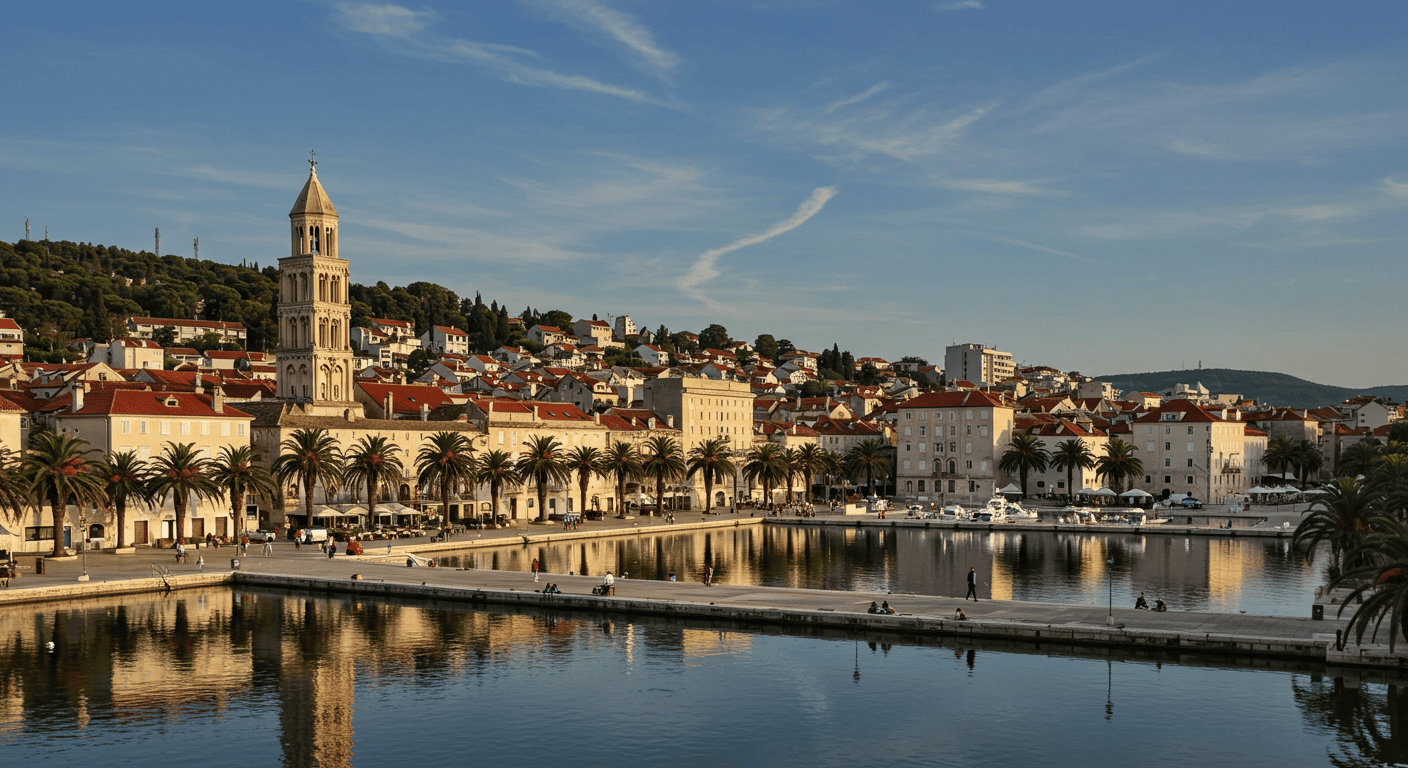
There is a particular quality to the light in Split at around six in the evening. It falls across the limestone facades of Diocletian’s Palace in long amber slabs, turning the stone a shade of gold that no filter has ever quite managed to replicate. The city smells of salt air and espresso and, if you are near enough to the Riva waterfront, of sunscreen applied approximately four hours too late. Church bells do their thing. Somewhere nearby, a klapa choir – the traditional Dalmatian a cappella form that UNESCO saw fit to protect – is rehearsing in an alleyway, their harmonies bouncing off walls that have been standing since the Roman emperor who commissioned them was still alive. This is Split in its element: ancient and alive, deeply local and thoroughly international, completely aware of how good it looks and somehow not insufferable about it.
Split works for a remarkably wide range of travellers, which is either a mark of its versatility or a sign that everyone has, at some point, been told to go. Couples celebrating milestone occasions – significant birthdays, anniversaries, the occasion of finally agreeing on a destination – find in Split the right combination of romance and edge; it does not feel like a set piece. Families seeking proper privacy, with pools and space and no lobby to negotiate, are served extraordinarily well by the villa landscape here, particularly along the Kaštela Riviera and out toward Omiš. Groups of friends who want excellent food, boat days, and cold wine on terraces until the kind of hours that cannot be mentioned in a family publication will not be disappointed. Remote workers who have decided that their home office does not, in fact, need to be at home will find reliable connectivity and a work-life balance so heavily tilted toward the life side that recalibration may be necessary on return. And those arriving with wellness ambitions – sea swims at dawn, olive oil in everything, the deeply restorative business of having nowhere in particular to be – will find the Dalmatian coast an excellent accomplice.
Getting Here Is Easier Than You Have Any Right to Expect
Split Airport – officially Resnik Airport, though almost nobody calls it that – sits about 25 kilometres west of the city centre, near the town of Kaštela. It is a remarkably civilised airport for one that handles around three million passengers a year, which is to say it has not yet descended into the specific kind of chaos that afflicts airports of similar size in hotter climates. Direct flights operate from across Europe, including London Gatwick, Manchester, Dublin, and a number of other cities whose residents have clearly identified the Dalmatian coast as the antidote to their particular climate. The flight from the United Kingdom takes around two and a half hours, which means you can leave a grey morning in England and be drinking a glass of Pošip on a terrace overlooking the Adriatic before dinner. This feels unreasonably good.
Transfers from the airport to the city or to your villa take between 20 and 45 minutes depending on traffic and the season. July and August will test your patience on the coastal road; it is worth arranging a private transfer rather than relying on taxis hailed at the rank. Most villa rental services can organise this in advance, and the difference in experience is considerable. Once in Split itself, the old town is best navigated on foot – it is compact and largely pedestrianised – while the surrounding region calls for a hire car. Roads along the Dalmatian coast are well-maintained and the driving is genuinely pleasurable outside of peak season. Ferries connect Split to the islands of Brač, Hvar, Šolta, and Vis, and the Jadrolinija ferry terminal sits conveniently close to the old town, meaning island day trips require only modest logistical effort.
The Table Here Is Not an Afterthought
Fine Dining
The restaurant scene in Split has matured considerably in the past decade. It now sits comfortably alongside the better coastal dining scenes in southern Europe – which is a claim that would have raised eyebrows fifteen years ago but is now simply accurate. The emphasis is on Dalmatian produce treated with intelligence: octopus slow-cooked under a peka – the domed iron lid that is essentially Croatia’s version of a slow cooker, and considerably more romantic – fresh sea bass crudo dressed with local olive oil, peka lamb that has had no interest in being rushed. Wine lists lean toward Dalmatian varietals, particularly Plavac Mali, a red with the kind of depth and tannin that makes you want to slow dinner down. Fine dining here tends not to announce itself with theatrics; it announces itself with the quality of what arrives on the plate.
Where the Locals Eat
The Pazar market, just outside the Golden Gate of Diocletian’s Palace, runs every morning and is where Split feeds itself. Farmers arrive from the surrounding villages and islands with produce that has frequently been picked that morning – figs, tomatoes, honey, dried lavender from Hvar, sheep’s cheese wrapped in cloth. This is not a tourist market. It is where grandmothers argue cheerfully about the price of peppers, and where you should go before breakfast if you want to understand what the food in Split’s restaurants is actually made from. For casual dining, konobas – traditional family-run tavernas – remain the backbone of the eating scene. Look for the ones down alleyways where the menus are handwritten, the tablecloths are slightly crooked, and nobody is checking in on Instagram. These places are not hiding; they simply have no need to advertise.
Hidden Gems Worth Seeking Out
The villages around Split, particularly those on the Kaštela Riviera and heading toward Omiš and the Cetina River canyon, have their own quieter dining culture that rewards the traveller willing to drive fifteen minutes inland. Fish grilled over charcoal in a courtyard where the owner’s family has been doing exactly this for three generations is not a niche experience here – it is simply Tuesday. Wine bars within the old town’s labyrinthine streets have proliferated in recent years, several of them serious about their selection of small-production Dalmatian and broader Croatian wines. Ask about local producers working with indigenous varieties; the conversation will frequently last longer than you planned and almost certainly involve a complimentary glass of something you did not order.
A Region That Earns Its Reputation and Then Some
Split occupies the central section of the Dalmatian coast, which positions it with almost unfair convenience. To the north, the Šibenik-Knin county contains Krka National Park, where waterfalls cascade through limestone gorges in a manner that makes you briefly question whether CGI has somehow been involved. To the south, the Makarska Riviera runs along the base of the Biokovo mountain range – a wall of grey limestone rising dramatically from the coast that provides both spectacular hiking and the deeply satisfying experience of swimming in clear water while looking up at a mountain. The Cetina River, flowing through its canyon toward the sea at Omiš, offers a completely different kind of Dalmatian landscape: green, dramatic, and largely overlooked by the kind of tourist who has decided that Croatia begins and ends with Dubrovnik.
The islands are the other dimension entirely. Brač, the nearest major island, is home to the famous Zlatni Rat beach – a long shingle spit that actually shifts position depending on wind and current, which is either geologically fascinating or inconvenient depending on where you have put your towel. Hvar combines high-season social energy with serious architectural heritage; its Renaissance cathedral square is genuinely beautiful, even if you have to navigate the party infrastructure to reach it. Šolta is the counterpoint – quieter, largely residential, popular with Croatians rather than international visitors, and producing some excellent olive oil. Vis, furthest out and for a long time closed to foreigners due to its military significance, retains a particular authenticity and is the choice of people who have been to Hvar once and drawn their conclusions.
What to Actually Do With Your Days
The honest answer is that the Adriatic will occupy a substantial portion of your time without any particular planning on your part. The water here is extraordinarily clear – visibility underwater can reach 30 metres in good conditions – and warm enough from late May through to early October to swim without the special kind of courage required by northern European seas. Beyond the sea, Diocletian’s Palace is a non-negotiable experience, not because you have been told it is important but because it is genuinely extraordinary: a fourth-century Roman imperial palace that has been continuously inhabited since it was built, so that its corridors and courtyards now contain restaurants, apartments, boutiques, and a cathedral built inside what was originally the emperor’s mausoleum. Diocletian is presumably fine with this.
Day trips by boat to the islands are the activity that most guests end up repeating. A private boat charter – which is entirely achievable at a range of price points – allows you to set your own pace, anchor in coves that larger vessels cannot reach, and eat lunch on deck with appropriate levels of ceremony. Evening walks along the Riva waterfront have been a Split institution since the concept of going for an evening walk was invented, and remain the best free activity in a city that has gradually become less free. The old town’s nightlife requires only navigation and a reasonable tolerance for noise; the bars within the palace walls stay lively until late, while the outlying districts of Bačvice and Spinut have a more relaxed, local energy.
For Those Who Need More Than a Sun Lounger
The adventure offering around Split is broader than visitors expecting a purely coastal holiday tend to anticipate. Sea kayaking along the coastline – particularly around the cliffs and caves near Šolta and the more dramatic sections of coast toward Omiš – delivers perspectives that no boat trip quite replicates. The Cetina River is the primary destination for white water rafting, with sections ranging from family-friendly floats through the canyon to more serious grade-three rapids further upstream; the scenery throughout is absurdly dramatic. Scuba diving in the Adriatic rewards properly: the underwater topography is complex and varied, with caves, walls, and several accessible wrecks including a Second World War submarine near Trogir that has become a serious diving landmark.
Cycling is underrated here, partly because the coastal road is not ideal for it but the inland routes – climbing into the hills behind Split toward the Mosor mountain range – are genuinely excellent for those with the legs and the inclination. Rock climbing has found a dedicated following on the limestone faces above Omiš and in several spots along the Biokovo range. And sailing, whether you bring your own experience to it or hire a skipper and simply turn up, is the activity that most successfully combines the adventure and the luxury ends of the spectrum. A week on a yacht from Split takes you through enough of the Dalmatian island chain that you return with a working knowledge of the coast and a strong opinion about which island you should have spent more time on.
Why Families Keep Coming Back
Split performs well for families in ways that are specific rather than vague. The old town, while dense and occasionally chaotic, is pedestrianised enough that younger children can move freely without the low-grade parental anxiety that attends pavement walking in cities with serious traffic. The beaches around the city – Bačvice, with its shallow sandy bottom, being the most celebrated – are calm and clear enough for children to swim without supervision requiring the kind of vigilance that exhausts adults. The local culture is genuinely child-friendly in the Mediterranean way that actually means something: children are welcomed in restaurants at all hours, indulged by waiters with a sincerity that tourists from the north tend to find slightly disorienting, and treated as participants in public life rather than manageable inconveniences.
The real advantage for families, though, lies in the villa option. A private property with its own pool removes entirely the choreography of hotel life – the shared breakfast at specific hours, the negotiation of pool furniture, the lobby crossings in wet swimwear – and replaces it with a rhythm defined entirely by the family itself. Villa properties around Split and the Kaštela Riviera frequently come with outdoor dining areas, multiple bedrooms that provide adults and children with genuine separation, and easy access to beaches and boats that make days self-sufficient. For multi-generational groups where grandparents are factored in, the villa format is not merely convenient but essentially the only format that works.
Two Thousand Years of Largely Eventful History
Split’s history is compressed in ways that no other city in Croatia quite matches. The Palace of Diocletian – begun around 295 AD and completed in 305 when the emperor retired to it, having abdicated because apparently even absolute power has its limits – defines the urban core in a way that is simultaneously remarkable and entirely taken for granted by the city’s residents, who have been eating lunch inside Roman walls for generations and have adjusted accordingly. The medieval overlay is significant: the Venetian influence that shaped much of the Dalmatian coast is visible in the campaniles, the loggia, and the specific quality of civic architecture that suggests someone cared quite deeply about how things looked.
The cathedral of Saint Domnius, housed in Diocletian’s octagonal mausoleum and operating as an active place of worship, manages to be both an architectural miracle and a living institution – which is not something many fourth-century Roman buildings have pulled off. The city museum and the adjacent collections within the palace complex are properly absorbing, presenting archaeological material in context rather than in the slightly airless way that some civic museums manage. The klapa choral tradition, the processional festivals of the Easter period, and the annual Split Summer Festival – running across July and August with theatre, opera, and music performed in palace courtyards – give the cultural calendar both depth and spectacle. This is not a city that exists only in summer.
Shopping That Rewards the Exploratory Impulse
The shopping inside Diocletian’s Palace is, predictably, variable. The main thoroughfares have their share of lavender sachets and Diocletian fridge magnets, which are there because someone is buying them and that someone is, statistically, everyone once and no one twice. Venture beyond these and the picture improves considerably. Local designers working with Croatian textiles and leather have established small boutiques in the less trafficked corners of the palace complex and in the Varoš quarter – the atmospheric old neighbourhood on the hillside above the west side of the palace, where the streets are steep and the souvenir-to-independent-business ratio tilts more favourably.
Croatian olive oil from Dalmatian producers is the most transportable serious purchase, and the Pazar market remains the best place to buy it directly from people who grew the olives. Local wine – Plavac Mali from the Pelješac peninsula, Pošip from Korčula, or one of the small-production island wines increasingly available in specialist shops around the city – travels well both physically and in terms of the memory it carries. Handmade jewellery incorporating Dalmatian coral and locally sourced stone is sold throughout the old town with a range of quality that rewards some discernment. The general principle applies: the further you walk from the Peristyle, the better the shopping tends to get.
Practical Matters That Will Actually Save You Time
Croatia uses the euro, having made the switch at the start of 2023, which removes the currency mathematics that formerly complicated Dalmatian holidays for visitors from the eurozone. Credit and debit cards are accepted widely, though smaller konobas and market vendors will still prefer cash. The language is Croatian, and while English is spoken fluently throughout Split’s hospitality and tourist sectors, a few words of Croatian – hvala for thank you, molim for please – will be received with the warmth that modest linguistic effort reliably generates in places that have been dealing with monolingual foreign visitors for several decades.
The best time to visit is May, June, and September – the months when the weather is reliably good, the sea is warm enough to swim in, the restaurants have their full menus available, and the city has not yet reached the density levels of July and August that make walking through the palace feel like a supervised group activity. July and August are peak season in every sense: the energy is high, the prices are high, the crowds are high, and the experience is still perfectly enjoyable but qualitatively different from the shoulder months. October is underrated; the light in autumn is extraordinary, many restaurants are still open, and the sense of a city returning to itself after the summer is quietly appealing. The tipping norm runs at around ten percent in restaurants; it is appreciated rather than expected in the way it might be in the United States. Split is a safe city by any reasonable standard; the usual urban awareness applies, but with considerably less urgency than in many comparable destinations.
On the Particular Intelligence of Renting a Villa in Split
Hotels in Split are fine. Some are genuinely good. But they are, almost without exception, hotels – meaning they come with the structural constraints that hotels have always come with and always will: fixed breakfast times, rooms that are comfortable but not spacious, pools that you share with people you did not choose, and a general orientation toward efficiency rather than toward the specific rhythms of your particular group. A private luxury villa operates on entirely different terms. The house is yours. The pool is yours – which, when you surface from a swim at seven in the morning to find the Adriatic catching the first light on the horizon, feels less like a holiday amenity and more like a life decision you made correctly.
The villa landscape around Split is genuinely excellent. Properties along the Kaštela Riviera offer direct sea access, private terraces, and the easy ferry and boat connections that make island life straightforward. Hillside villas above the city command views that shift from white heat at noon to deep amber at dusk in ways that require no effort to appreciate. Larger properties – five, six, or eight bedrooms – accommodate the kind of multi-generational or multi-couple group that a single hotel booking simply cannot serve with any coherence. Many villas come with chef and concierge services, which allows the genuinely useful question of what to eat and where to go to be handled by someone with local knowledge rather than a review aggregator. For remote workers, fibre and Starlink connectivity have made even fairly remote properties serious working environments – the kind where the background on video calls requires some explanation to colleagues still in their actual offices.
For wellness-focused guests, private pool access for early-morning swimming, proximity to hiking and sea kayaking, and the deep structural calm of a property with no lobby, no schedule, and no other guests is its own form of therapy – and considerably less expensive than the clinic variety. Browse our collection of luxury villas in Split with private pool and find the one that reorders your priorities in all the right ways.
More Split Travel Guides
What is the best time to visit Split?
May, June, and September offer the best balance of warm weather, swimmable sea temperatures, and manageable visitor numbers. July and August are peak season – energetic, busy, and more expensive. October is an increasingly popular shoulder month, with softer light, quieter streets, and most restaurants still operating. Spring arrivals in April will find the city unhurried but the sea still cool for swimming.
How do I get to Split?
Split Airport (Resnik) is approximately 25 kilometres west of the city and receives direct flights from across Europe, including London Gatwick, Manchester, Dublin, Amsterdam, and numerous other cities throughout the summer season. Flight time from the UK is around two and a half hours. Private transfers from the airport to Split city or to villas along the Dalmatian coast take between 20 and 45 minutes depending on location and traffic.
Is Split good for families?
Split is very well suited to families. The old town is largely pedestrianised, beaches near the city are calm and clear, and the local culture is genuinely welcoming to children in a way that goes beyond policy. The greatest advantage for families is the private villa option: properties with private pools, multiple bedrooms, and outdoor dining spaces allow families to establish their own rhythm entirely independent of hotel schedules and shared facilities.
Why rent a luxury villa in Split?
A private villa gives you space, privacy, and a rhythm that a hotel cannot replicate. Your pool, your terrace, your schedule. For groups – families, friends, multi-generational parties – the villa format provides the shared common spaces and private bedroom separation that actually allow people to enjoy being on holiday together. Many Split villas come with chef, concierge, and housekeeping services, meaning the logistical questions are handled without any particular effort on your part.
Are there private villas in Split suitable for large groups or multi-generational families?
Yes. The villa portfolio around Split includes properties sleeping eight, ten, or more guests across multiple bedroom configurations. Many larger villas offer separate wings or annexes that allow adults and children – or different family units – to have genuine independence while sharing common areas such as pools, terraces, and dining spaces. Staffed villas with chefs and housekeepers are available at the upper end of the market and significantly reduce the operational burden on whoever would otherwise be coordinating meals for twelve.
Can I find a luxury villa in Split with good internet for remote working?
Yes, and the connectivity situation has improved markedly in recent years. Many villa properties in and around Split now offer fibre broadband, and Starlink installations have extended reliable high-speed connectivity to more remote coastal and hillside locations where traditional infrastructure was previously inconsistent. When booking, it is worth confirming upload and download speeds if video calls are a regular requirement – any reputable villa rental service should be able to provide this information in advance.
What makes Split a good destination for a wellness retreat?
The combination of climate, landscape, and pace of life makes Split a naturally restorative destination. Early-morning sea swimming, hiking in the Biokovo range or along the Mosor mountain trails, sea kayaking, and fresh Dalmatian food heavy on olive oil, fish, and seasonal vegetables all contribute to a physical reset that feels earned rather than prescribed. Private villa amenities – pools, outdoor spaces, and the absence of hotel-lobby energy – provide the structural calm that makes genuine unwinding possible. Several spa and wellness facilities operate within Split and the surrounding region for those wanting structured treatment alongside the outdoor activities.
